Vapor Drive through Floors
Vapor drive is the diffusion of moisture in the form of a gas or vapor. If unimpeded, the vapor is usually dispersed to the atmosphere. Obstructions of this water vapor’s travel through a building envelope can result in moisture buildup or condensation and eventual water damage to flooring or other elements at a building’s envelope. Vapor drive can occur at floors, walls, and ceilings: all permeable or semi-permeable materials are susceptible. It can also travel in either direction, depending on the specific conditions present.
Nature seeks a balance: heat travels towards areas of lower temperature, and high moisture travels towards areas of less moisture. Therefore, differences in moisture levels between interior and exterior drive this transfer, and the rate or at least the potential for this transfer correlates with the magnitude of the difference.
Vapor drive through floors is more common in southern climates. This is particularly true with regard to concrete slabs on grade. Vapor drive through walls and ceilings is more common in northern climates, as discussed here.
Vapor drive can occur through a concrete slabs on grade floor. This is the diffusion of groundwater in vapor form up through the concrete slab. A properly installed vapor barrier, installed on the ground before the concrete is placed, is crucial to prevent this. The installation of a vapor barrior beneath interior slabs is required by nearly all building codes. Often, 6mil poly sheeting with lapped and taped joints is specified. However, this was not always provided in older homes. In addition, breaks in the vapor retarder, such as at laps, slab edges and around plumbing penetrations, may allow moisture in the ground to reach the slab.
Wood flooring, including engineered, laminate, or solid wood planks placed over concrete slab on grades are particularly vulnerable to vapor drive. An exposed concrete slab such as in a garage or warehouse may have vapor from groundwater beneath it continually traveling up through the slab. However, no one notices because there is nothing to trap the moisture or be damaged. The vapor is simply dispersed into the interior atmosphere. The existence of the vapor drive and manifestation of a problem only occurs when a vulnerable material, such as wood flooring, is installed over such a slab.
Many wood flooring manufacturers require that concrete slabs be tested for moisture vapor transmission rates to determine whether or not the slab is suitable for their flooring. Some manufacturers state in writing that all concrete slabs to receive their flooring should have a minimum 6 mil poly sheeting between the ground and the concrete. This is consistent with typical building code requirements. Poly sheeting or liquid applied vapor retarder are sometimes placed between the slab and wood flooring to prevent moisture vapor from reaching the wood. While never correct to encapsulate wood structures with a vapor barrier on both sides, concrete alone is generally impervious to rot and the sustained presence of elevated moisture.
Many wood flooring products are finished with a polyurethane or other coating that obstructs the flow of water vapor. A rubber or other impermeable floor mat placed over wood flooring can exacerbate or the problem. The moisture makes it way up through the sub floor, through the wood flooring, but is trapped by the finish or floor mat. The moisture content then begins to build within the susceptible flooring materials until stains and warping begins to occur, and the problem is then noticed.
While less common, a problem with vapor drive can also occur in carpet and vinyl flooring. This can happen when a plastic or rubber mat is placed over carpet for an extended period. When the mat is removed, moisture in the carpet is noticed. In the case of vinyl flooring, it is not the vinyl itself that is usually affected but the adhesive used to adhere it to the floor below. This is particularly true in older or latex-based adhesives, which are often more susceptible to the moist alkaline environment expected when exposed to concrete.
Vapor drive can also occur through wood framed floor structures. This is particularly true when the framed floor is over a crawlspace with high or marginal moisture conditions, such as that which can result from inadequate crawlspace ventilation. Similar to a concrete slab on grade, vapor drive through a wood framed floor is often discovered when a rubber mat or other impermeable barrier is removed.
A different but related problem can manifest several months or years after carpet is replaced with vinyl or tile flooring, particularly in southern climates. Carpet and the foam padding below it act as a layer of insulation. Once removed, the subfloor is now maintained at a cooler temperature due to interior air conditioning. This increases the rate of condensation on the underside surface of the subfloor exposed to the relatively warm and humid air within the crawlspace. These circumstances can occur in northern climates when a previously heated building is no longer heated over a winter, discussed here.
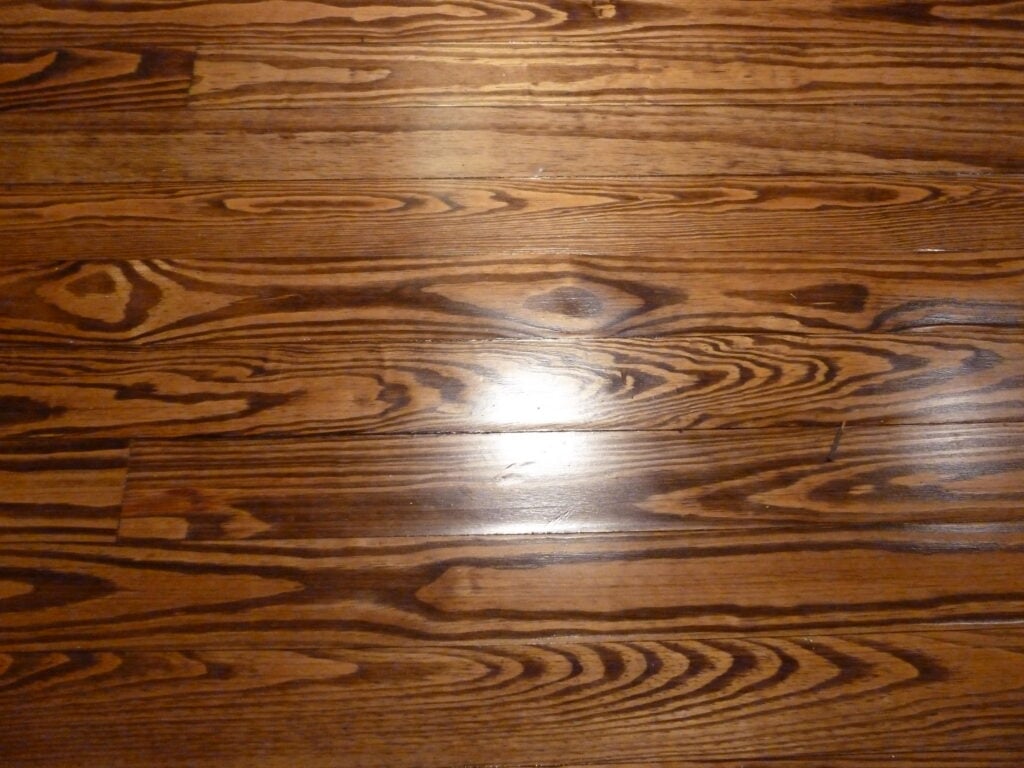
Diagnosing vapor drive usually includes a process of elimination, taking moisture meter readings, and considering the location and distribution of the moisture problem. Widespread damage or elevated moisture readings indicate vapor drive as the problem. The following is a photograph showing cupping from vapor drive in a wood flooring planks over a concrete slab on grade: