

Vapor Drive through Walls
Vapor drive is the diffusion of moisture in the form of a gas or vapor through a material. If unimpeded, the vapor is usually dispersed to the atmosphere. Obstructions of this water vapor’s travel through a building envelope can result in condensation and eventual water damage to flooring or other elements at a building’s envelope. Obstructions can be either something that stops the vapor, or condensation of the vapor itself into liquid water. Vapor drive can occur at floors, walls, and ceilings: all permeable or semi-permeable materials are susceptible to it. It can also travel in any direction, but always from areas of higher to lower moisture.
Nature seeks a balance: heat travels towards areas of lower temperature, and high moisture travels towards areas of less moisture. Therefore, differences in moisture levels between interior and exterior drive this transfer, and the rate or at least the potential for this transfer corresponds to the magnitude of the difference.
Vapor drive through walls and ceilings is more common in northern climates. Vapor drive through floors is more common in southern climates, and this is discussed here.
Vapor Drive through Walls
The amount of water air can hold is exponentially proportional to its temperature. For every 1 degree F increase in temperature, air can hold approximately 4% more water vapor. This means that cold air can hold little water, but warm air can potentially hold much water. Therefore, in northern climates during cold winter weather, the exterior air is always extremely dry relative to the heated interior of almost all buildings. This in turn means that a significant vapor pressure differential exists between the interior and exterior. In other words, not only the heat but the moisture in the interior air wants to move outward.
Thus, a thermal gradient thus exists across the cross section of an exterior wall. On the interior side of the wall, the temperature may be a comfortable 70 degrees F. However, on the exterior side of the same wall, the temperature may be 20 degrees or less. This means that in the space of 8 inches or less, the temperature drops at least 50 degrees. At some point within that cross section, the temperature can drop below the dew point, and some or most of the vapor in the air within the wall condenses into liquid.
Two conditions can potentially exacerbate the problem. First, allowing high interior humidity within the building. This can result from an indoor heated pool or spa. In such cases where high interior humidity is expected, a robust dehumidification system combined with a negative pressure ventilation system should be considered. The dehumidification system removes water from the air. The ventilation system keeps the interior space at a constant negative pressure. This ensures that cold, dry air is drawn into the interior, rather than moist air escaping through and condensing within the building envelope.
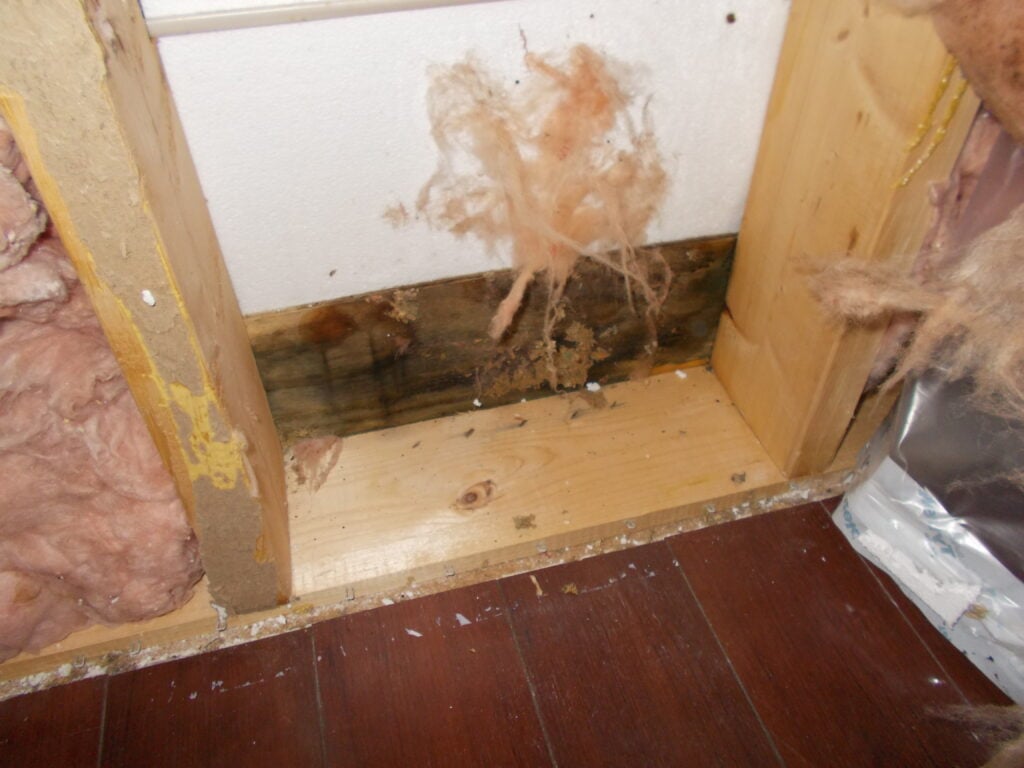
Second, the existence of a vapor retarder or barrier at an exterior wall in northern climates. For this reasons, vapor retarders such as poly sheeting should never be applied to an exterior side of a wall in northern climates. And sufficient vapor permeability of any exterior insulation or siding product should be confirmed before it is installed. The photograph below shows moisture damage at the exterior side of a framed wall. The thin polystyrene board insulation applied just below the exterior siding at to the exterior (far) side of the studs was manufactured with a plastic vapor retarder applied to one side. This was enough to trap vapor drive to condense on the exterior side of the framed wall.
The above discussion applies in reverse in tropical climates: warmth and humidity at the exterior wants to drive towards a relatively cool and dry interior air. Poly sheeting or foil vapor barrier placed immediately behind interior drywall on a south facing CMU wall can trap moisture driving inward from the exterior. Such problems of first manifest as damage to the flooring and baseboards below. When the drywall and vapor barrier are removed, moisture at the CMU and rot at the wood furring strips attached to the block can be revealed. If the foil or poly sheeting had not been present, the moisture may have dispersed into the interior air through the drywall. Instead, it can be trapped by and build up behind the vapor barrier.