

Debonded or Tented Ceramic Floor Tile on Concrete Slab
Several methods are used to install floor tiles over concrete slabs. These include the use of mortar beds and membranes of various types. This discussion focuses on debonded and tented ceramic floor tile that were installed directly over a concrete slab on grade using thinset mortar.
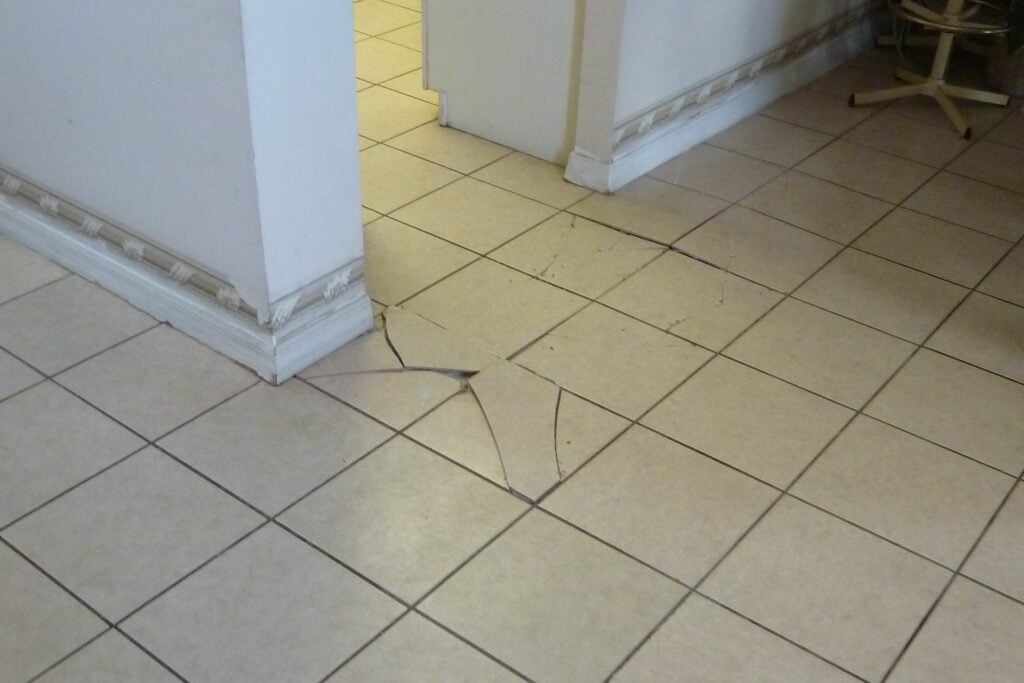
Thinset mortar is often used to bond ceramic tile to concrete slabs because this method is relatively fast and inexpensive. Bond failures using this installation method are often the result of defect(s) with the original tile installation. These defects can include problems with the slab surface preparation, the thinset mortar or installation, insufficient movement joints, or a combination of these. Debonded floor tiles are susceptible to tenting, which is two or more floor tiles physically lifting up from the slab. This in turn makes the tiles more susceptible to cracking and breakage from normally applied loads such as foot traffic.
Ceramic tile bond failures are often related to improper preparation of the concrete slab. The Handbook for Ceramic, Glass, and Stone Tile Installation published by the Tile Council of North America (TCNA) recommends that the concrete slab to receive the ceramic tile be “…well cured, dimensionally stable, and free of cracks, waxy or oily films, and curing compounds.” It also recommends that the slab surface meet flatness tolerances.
Both the TCNA and the Ceramic Tile Institute of America (CTIOA) field reports recommend that concrete slabs to receive thinset mortar have a steel trowel and fine broom finish. The TCNA recommends: “When (curing compounds are) used, mechanical scarifying is necessary.” This means that for a proper bond between the mortar and the slab to occur, the slab surface should not be smooth. Slab preparation should include:
- repairing existing cracks
- thoroughly cleaning to remove all foreign materials such as drywall mud, oil and paint
- roughening the slab surface
The underside of the ceramic tile must also be rough and clean for a proper bond with the mortar.
Ceramic tile bond failures also occur due to problems with the preparation and application of the thinset mortar. Problems with preparation may include using an improper ratio of water in the mortar mix and re-tempering the mix by adding water after it has already begun to set. In addition, the mortar used must be compatible with the tile. Potential problems with workmanship include allowing too much time between the mortar mixing and the tile placement, not properly pressing or beating the tiles into the mortar, improper mortar coverage or thickness, and not allowing enough time before foot traffic or other loads are applied to the new floor.
Insufficient movement joints can also contribute to a loss of bond between the tile and underlying slab. The TCNA Handbook states the following with regard to movement joints:
Perimeter and field movement joints within a tile installation are essential and required. Location and frequency of joints (shall be) 20 feet to 25 feet in each direction.
Elevated slabs, such as those in high-rise buildings, require tighter joint spacing of 12 feet due to the tendency of these slabs to deflect more than slabs on grade. Movement joints are also required by the Ceramic Tile Institute of America (CTIOA). Field Report 2004-6-4 states:
Commonplace in the tile industry today is reluctance on the part of architects and designers to specify movement joints in concrete work in accordance with recommended industry standards. The fact that appropriately specified movement joints can disrupt and interfere with the aesthetic and cosmetic value of a particular project make this reluctance understandable; however, it does not make their presence any less necessary in order to maintain the overall integrity of the finished tile work. In addition, many throughout the industry fail to realize that movement joints must be brought up through the slab, and ultimately through the tile work, and never be bridged with tile or stone.
One or several of these construction defects are sufficient to cause bond failure over time. Bond failures usually start at smaller areas that grow larger over time. Once a larger area of floor tiles debond, compressive forces can build in the plane of the tile from normal variations in humidity, concrete shrinkage, temperature, differences in material thickness and coefficients of thermal expansion between the ceramic tile and concrete. These forces can no longer be as distributed from the debonded tiles by adhesion and shear through the mortar interfaces with the slab. This can lead to compressive forces building up in the plane of the debonded floor tiles sufficient for the tiles to lift and tent.
The following photograph shows tented and cracked ceramic floor tiles:
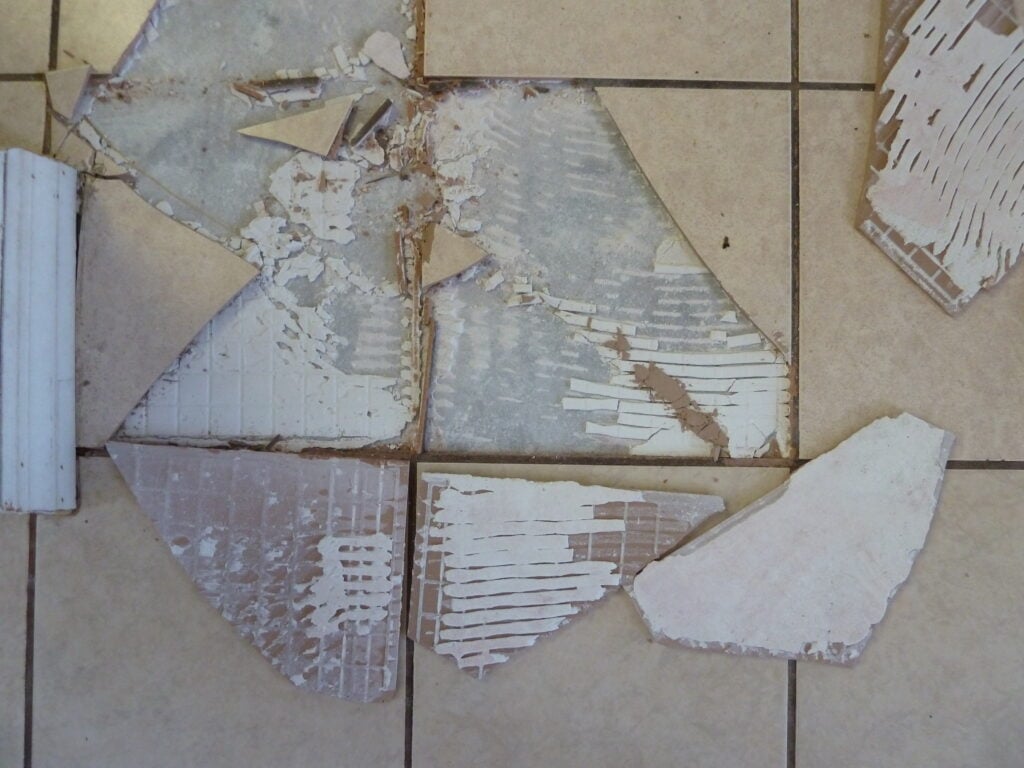
The next photograph shows debonded, tented and cracked floor tiles. Note the slab and thinset mortar visible beneath the tile with the failure planes between the mortar/tile and mortar/slab:
ADDITIONAL RESOURCES:
TCNA – Handbook for Ceramic, Glass, and Stone Tile Installation
CTIOA – Field Reports