Loose Mortar-Set Roof Tiles
There is often concern over the condition of mortar set roof tiles being loose in place with the bond failure plane between the tile and the mortar (as opposed to between the mortar – membrane). Mortar set tiles become loose for a number of reasons related to original installation, such as improper mixing and application of the mortar at the time of construction, misplacement of the mortar, or insufficient mortar under the tile. Some roof tile manufacturers require that the tiles be wetted prior to being placed on the roof. If not the tiles may be too dry and may absorb moisture from the mortar. If this happens the top portion of the mortar loses water and the hydration process may be cut short. As a result of incomplete hydration the top portion of the mortar is weakened and susceptible to premature bond failure. Roof tiles may also become loose due to the expansion and contraction forces that occur from exposure over time. This is usually in conjunction with a weak mortar bond that allows environmental stresses to have a detrimental effect on the bond.
The problem with mortar set roof tiles losing their bond is a long known and documented problem. The following excerpts were taken from an industry sponsored report: TECHNICAL PUBLICATION 155 titled “The Loss of Bond Between Roof Tiles And Mortar on Pitched Roofs” by Professor Wilson C Barnes, AIA and Jose Mitrani, P.E., dated November 12, 1994. This technical publication was a research project sponsored by The Building Construction Industry Advisory Committee under a grant from the State of Florida under the Department of Education.
“In recent years it was evident that problems existed with clay and concrete tile bonding to mortar in newer installations. Many tile roofs appearing tight at the time of installation were discovered later to have suffered a loss of bond between the tile and setting mortar. Often, this was occurring shortly after installation.
– The problem had been identified prior to Hurricane Andrew and many segments of the construction industry were experiencing woes arising from this phenomenon. These ranged from the simple issuance of code violations to lawsuits for large sums of money.
– The Dade County Board of Rules and Appeals began addressing loose roof tile in 1987, and its Roofing Committee has been working with industry since then on the problem. Respected and licensed roofers had noted the loss of bond problem as being prevalent even in tight quality control situations. In the fall of 1991, the Board agreed on certain material and procedural changes that would provide more satisfactory installations in the short term while industry research and product improvement could be carried out.
– The report presented to the Roofing Committee of the Dade County Board of Rules and Appeals Board by John Pistorino cites the following items which are discussed as reasons for the lack of bond between clay or concrete tiles and mortar. The word lack is used intentionally to emphasize that in many cases breakdown occurred before a bond had opportunity to form:
- Poor workmanship
- Improper mix of cement, sand, and water for mortar resulting in strength of less than 1800 psi
- Drying out of mortar before application
- Walking on tile prior to set-up of the mortar
- Not keeping tiles cool during curing of the mortar
- Not enough mortar being used
- Improper placement of mortar paddies
- Incompatibility of materials
- Tile is so dense and smooth that mortar will not adhere
- A bond breaker used to release the concrete tile from the steel form during production may affect the adherence of mortar to the tile
- Tile shape and interlocking may cause movement similar to expansion and contraction of concrete decks creating a shear plane at the mortar interface”
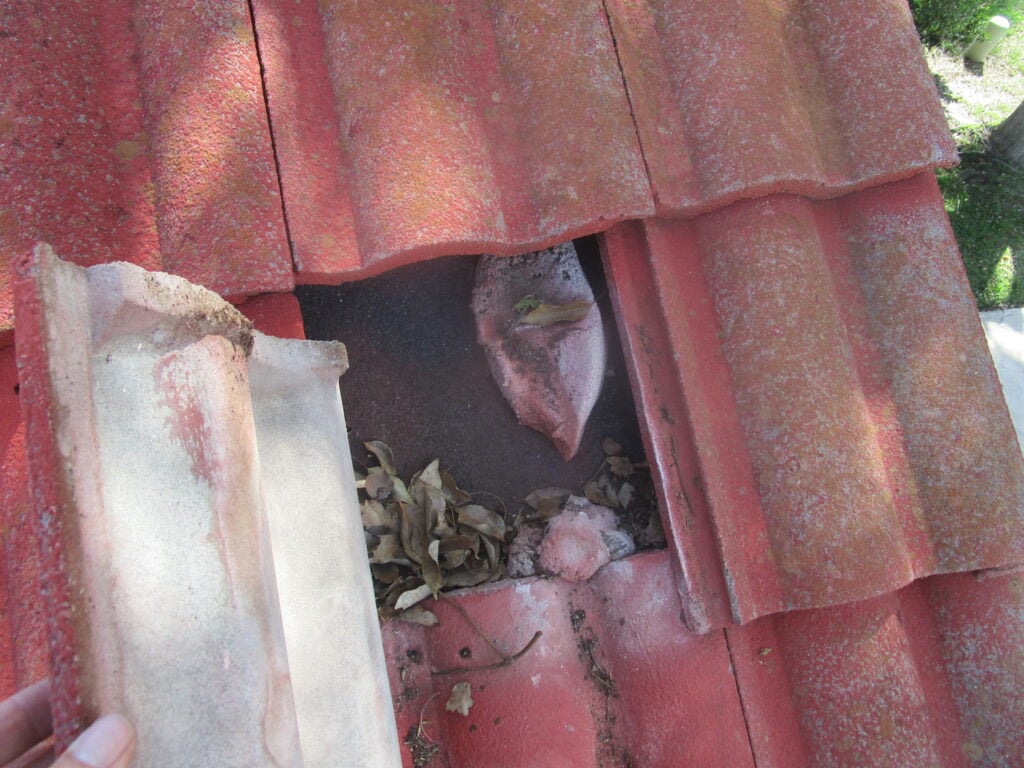
Because of this problem some building codes were changed in the mid 1990s to require other attachment methods, including structural foam-type adhesive, epoxy mortar, or mechanical fastening. The photograph below shows relatively small, de-bonded mortar paddies beneath a concrete tile:
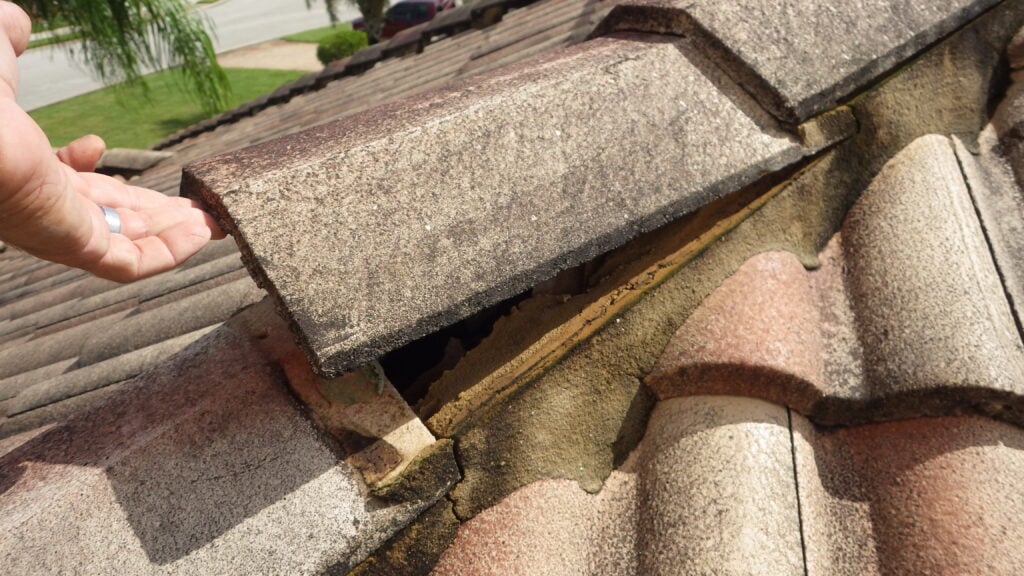
Ridge tiles are perhaps the most commonly found loose mortar set tile. Many older roofs have mechanically fastened field tiles but ridge tiles that are only adhered with mortar. These tiles are more susceptible to wind damage for at least two reasons. First, they are only restrained by the limited weight and bond of the ridge tile immediately above. Second, their location at a ridge is a higher wind pressure zone according to the ASCE 7. Such a tile is visible in the photograph below. Note the adhesive exposed on the tile beneath the lifted tile: