

Cracks at Ceramic Floor Tile over Concrete Slabs
Ceramic floor tiles are also commonly installed over a concrete slab on grade. There are different methods of installing ceramic tile over a concrete slab. One method involves the use of a thick (usually 1 to 2 inches) mortar bed over a cleavage membrane. This membrane separates the floor tile and mortar bed from the slab, allowing the tile installation to ‘float’ over the slab, and thus preventing cracks in the slab from propagating up through the tile. Another method uses an isolation membrane with thinset mortar. These two methods are not considered in further detail here.
A third and probably most common tile-to-slab installation uses thinset mortar to directly adhere ceramic tiles to an exposed concrete slab surface. This method is widely used because it is faster, uses less materials, and is less expensive. However, several issues can lead to cracking of ceramic floor tile directly adhered to a concrete slab.
Cracks in concrete slabs are relatively common. Floor tiles directly adhered to a concrete slab are susceptible to ‘reflective’ cracking. This occurs when cracks in the concrete slab below reflect up through the floor tiles. As indicated above, mortar beds and cleavage or isolation membranes installed between the tile and the slab are employed to help prevent this type of cracking.
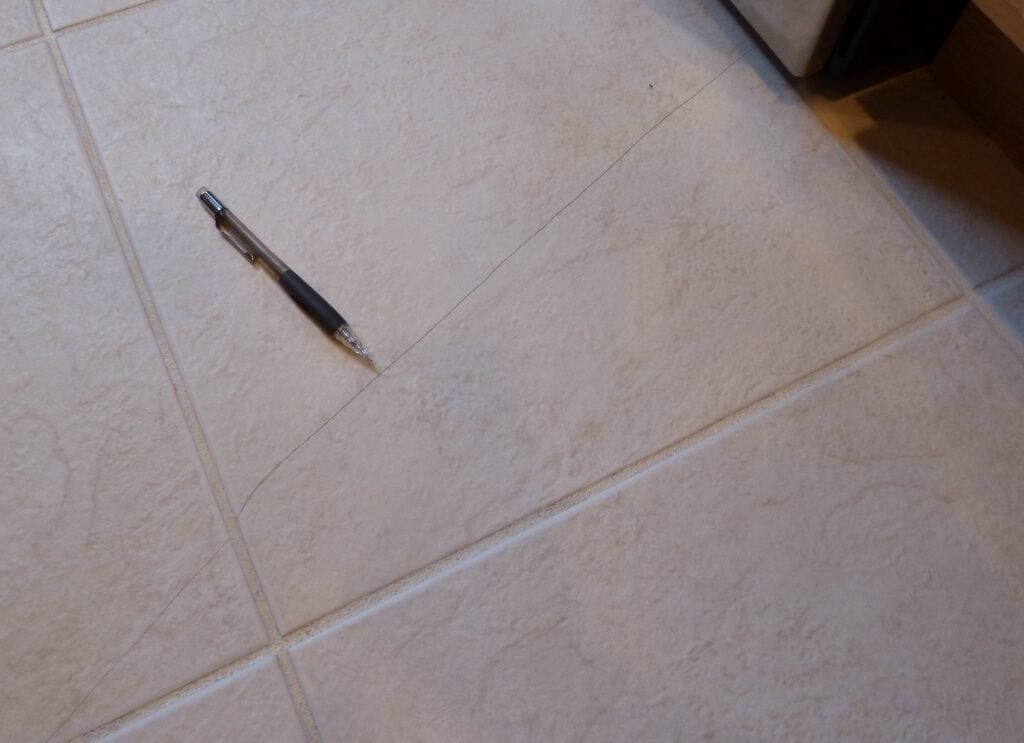
Many if not most cracks in concrete slabs result from concrete shrinkage and thermal movements. These cracks may not be structurally significant as it is concrete’s nature to crack. The following photograph shows a reflective crack in ceramic floor tiles directly adhered to a concrete slab. This crack extends across grout joints, and the tiles adjacent to the crack produce a solid ringing sound when tapped, indicating the tile was bonded to the slab below. No visible or measurable displacement across the crack. All these conditions indicate that the crack was the result of a shrinkage crack in the concrete slab below reflecting up through the attached tile. This crack was not indicative of a structural concern:
A concrete slab on grade may also crack due to significant settlement, which is often a longer term process usually related to inadequate support from the soil beneath the slab. It usually manifests as differential vertical movement across the cracks, and displacement of the slab itself at areas. Significant differential settlement is a structural concern that should be remedied.
Floor tile may also crack from the loss of bond between the floor tile and the slab. Loss of bond may result in loose or tented floor tiles. Floor tiles affected in this way are not fully supported by the underlying mortar. This increases their susceptibility to cracking due to foot traffic and other normally applied loads. Debonded and tented floor tiles over concrete slabs is discussed in more detail here.
Determining whether floor tiles are bonded or not is simple. Use a golf ball or stick to tap different tiles and different areas of each individual. A bonded (adhered) tile produces a solid higher pitch ringing sound while debonded tiles sound is obviously more dull and hollow.
ADDITIONAL RESOURCES:
TCNA Handbook for Ceramic, Glass, and Stone Tile Installation
ANSI A108/A118/A136.1 – Specifications for the Installation of Ceramic Tile
ANSI A137.1 – Specifications for Ceramic Tile