

Cracks at CMU Walls from Shrinkage and Thermal Effects
Cracks in concrete masonry unit (CMU) walls are common, and usually reflect through an exterior stucco finish. Typical shrinkage and restrained thermal movement cracks in CMU walls often manifest as generally vertical cracks. While normal shrinkage cracks in CMU walls are typically not a cause for structural concern, they present a potential source of moisture intrusion. These types of cracks usually occur at fairly regular intervals along the length of a long wall, and more frequently at wall openings such as windows or doors because of the reduced strength of the wall at openings.
Similar to shrinkage cracks in concrete slabs on grade, shrinkage and thermal movement cracks in CMU walls primarily occur due to restrained movement. One portion of a wall is restrained with respect to another, and this induces tensile forces within the wall. As with plain concrete, CMU is strong in compression but weak in tension. Therefore, restrained tensile forces within the CMU wall often lead to cracking. The restraint occurs as the result of friction and mortar bond between individual blocks and other structural elements such as the foundation, columns, perpendicular walls, etc.
CMU shrinkage occurs due to a reduction in moisture content and carbonation. Drying shrinkage occurs in all three cement products used within a CMU wall: block, mortar and grout. However, the block itself makes up the majority of wall area. As such, it is block shrinkage properties that are the primary consideration in drying shrinkage. The individual CMU drying shrinkage potential depends upon several factors including curing and moisture content, cement content, and aggregates used in the block. Typical CMU drying shrinkage varies, but a range of approximately one-fourth to one-half inch in 100 linear feet of CMU wall can occur. Carbonation is a contributor to CMU shrinkage. This occurs when carbon dioxide reacts with calcium hydroxide, forming calcium carbonate. This process reduces alkalinity and causes slight reductions in volume over time.
CMU walls also crack due to restrained thermal movement. As with most materials, CMU expands when heated and contracts when cooled. A fifty degree Farenheit temperature change can result in more than 1/4-inch length change in 100 linear feet of CMU. Obviously, the temperature change that a wall experiences depends upon the local climate, but it is also affected by exposure direction, wall color, etc.
Shrinkage and thermal effects should be accounted for in masonry design. This may be accomplished through the use of well-cured and dry block, horizontal joint reinforcement, and control joints. Similar to sawcuts in a concrete slab on grade, control joints effectively break a long wall into smaller segments. In this way, the individual wall segments can contract and expand individually. The movement is accommodated at the joint, where a flexible and weatherproof sealant is often utilized as part of the control joint.
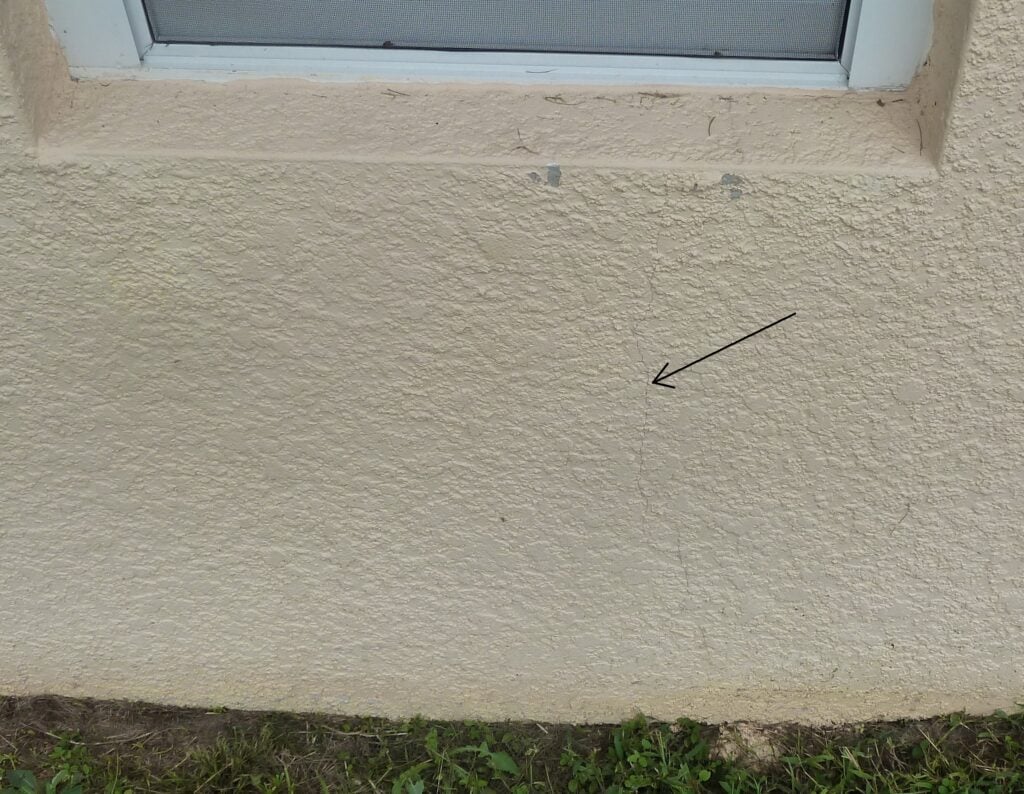
The following is a photograph of a crack in exterior stucco typical of CMU wall shrinkage and restrained thermal movement. This crack was not indicative of structural damage or concern:
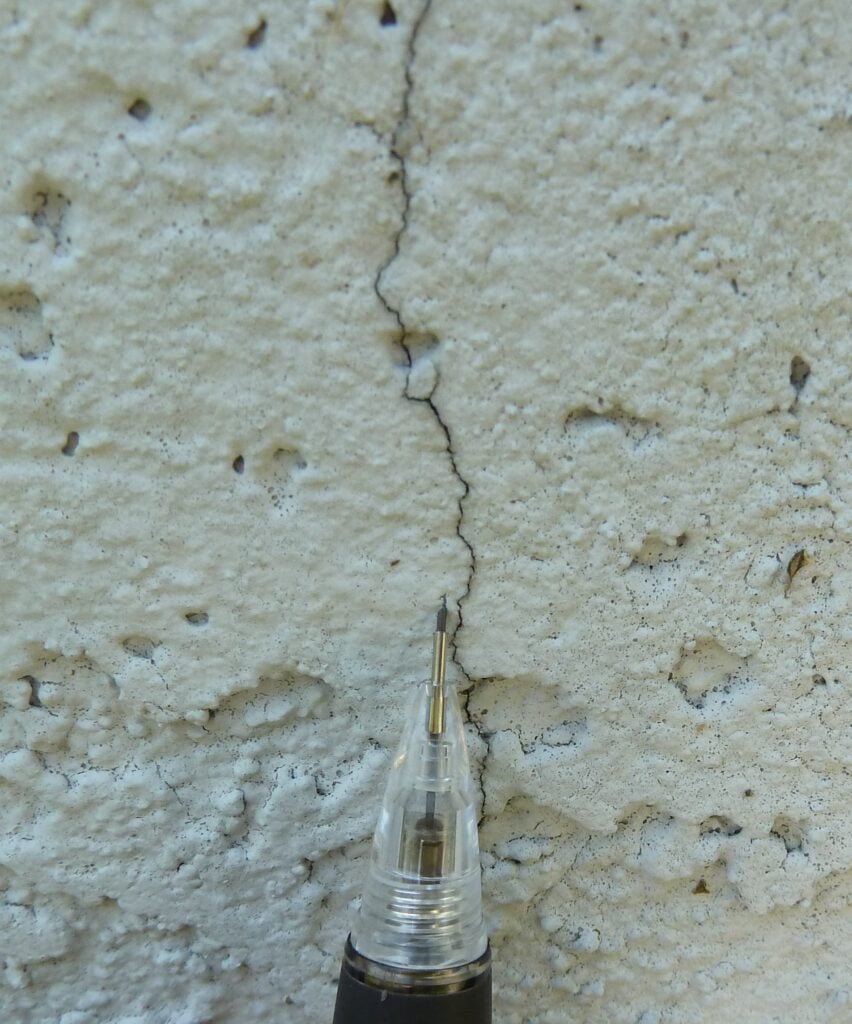
The following photograph is a closeup of a CMU shrinkage crack. Note the hairline width of the crack and the lack of differential movement across the crack, either longitudinally or laterally:
ADDITIONAL RESOURCES:
ACI 530 – Building Code Requirements and Specifications for Masonry Structures
NCMA TEKs