Shear
Shear is not a difficult concept. Imagine holding a stick with two fists close together. Now, with both hands gripping the stick tightly, move one hand forward while keeping the other still. The force you just applied on the stick is called shear. In beam design, the points of maximum shear are often, but not always, at the beam supports. Shear is one of the primary considerations in beam design, together with bending and deflection. It is also a factor in the design and analysis of many other components including slabs, foundation, connections, etc.
In engineering terms, shear can be described as a force acting parallel or tangential to a material’s surface, tending towards internal layers sliding past one another in opposite directions. When shear is combined with bending stress, it can result in diagonal cracks. A diagonal shear crack near a beam’s support will always be in the direction that would allow the beam to fall. In other words, if a diagonal shear crack was rotated 90 degrees, the beam would simply rest on the crack and not be expected to fall. This is a simple indication of whether or not a crack near a beam’s support is related to shear.
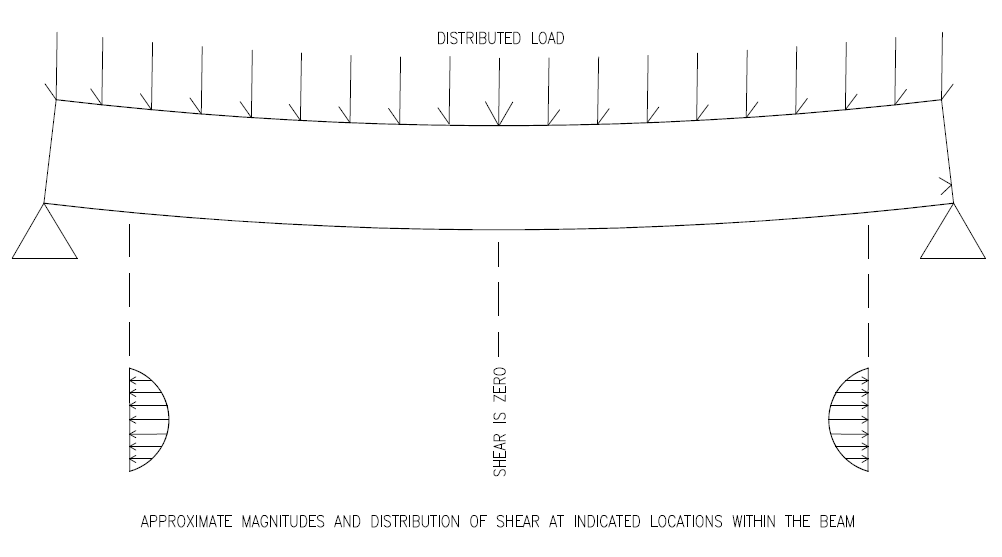
Shear diagrams reflect the amount of shear at any given point along the length of the beam. They depend on load and support distribution. For instance, in a simply supported beam with a uniform distributed load, the shear is maximum but opposite at each end support, and zero at midspan. Thus, the shear diagram in this case is a long diagonal line intersecting the horizontal (zero) axis at mid span.
A visual representation of the actual shear stress within any particular cross section of the rectangular beam takes the shape of a half oval, cut vertically. The shear stress is thus maximum at the middle and zero at the beam’s top and bottom. These internal stresses vary along the length of the beam in accordance with the shear diagram discussed above.
In concrete beam design, steel stirrups are placed at relatively tight intervals at areas of higher expected shear. These stirrups are placed in order to cross the potential diagonal shear planes, and thus prevent the beam from cracking and separating.
Shear is a primary consideration in beam and other component design. It can be precisely analyzed, predicted and accounted for with math and knowledge of material strength, section capacity, expected loads, span, safety factors, etc.