

Rot & Deterioration
Rot reduces the strength, stiffness, and bearing capacity of structural wood members. As the wood deteriorates, the affected members lose their ability to resist bending. A weakened joist may sag between supports, causing visible deflection such as sloping floors, soft spots, gaps at baseboards, cracked finishes, or doors that no longer close correctly. If rot occurs at the bearing end of a joist or beam, the member can crush where it is supported, causing a downward displacement of the floor.
Roof structures can be affected in a similar way. Rafters, trusses, roof sheathing, and wall plates depend on continuous, dry, sound wood to transfer roof loads safely. Leaks around flashing, gutters, chimneys, and roof penetrations can cause or contribute to decay in wood exposed to these leaks. Once stiffness or a member is otherwise weakened, rafters or sheathing may sag.
Wood rot is usually caused by fungi that grow when wood stays moist for an extended period. Its growth is accelerated by warmer temperatures, darker conditions and stagnant air, and other factors. Wood rot is caused by fungi, which requires five essential elements to grow: suitable substrate (food), air (oxygen or carbon dioxide, in some cases), suitable surface to grow on, appropriate temperature range (varies by species), and moisture. The control of fungal growth requires the elimination of one or more of these requirements. From a practical standpoint, there is little that can be done to control the first four listed requirements. Common fungi found in buildings tend to subsist on things from which they are constructed: wood, wallpaper, paint or other finishes, drywall, etc. Some species subsist on dust and gases in the air. It is virtually impossible to eliminate the nutrient supply, air, and growing surfaces. The optimal temperature for fungi growth is generally the same as that conducive to human comfort. Given all the above, moisture is the primary element that can be reasonably controlled in order to reduce the potential for fungi growth and resulting rot. More lighting and air movement will generally benefit as well, as fungi growth is promoted by low lighting and air movement.
Under suitable conditions, fungi can grow deep into wood surfaces, resulting in structural decay, or rot, over time. For fungal colonies to grow in wood and produce decay, the moisture content of the wood fibers must exceed the fiber-saturation point. This varies from about 25% to 30%, depending on the species of wood. An elevated humidity level of 60% or more can sustain fungal colonization on many surfaces. In general, fungi causing wood rot cease growing at temperatures below 40 degree F.
Without suitable growth conditions, the fungi cease to grow, become dormant or die. However, before fungi die, they can form and disperse spores (sporulate) as a survival mechanism. Depending on the fungi type, spores can germinate when the humidity level reaches 60% or more or liquid water becomes available. Early leak detection and correction, proper ventilation, and the use of dehumidifiers to lower humidity level are strategies to inhibit fungal growth and the potential for rot damage.
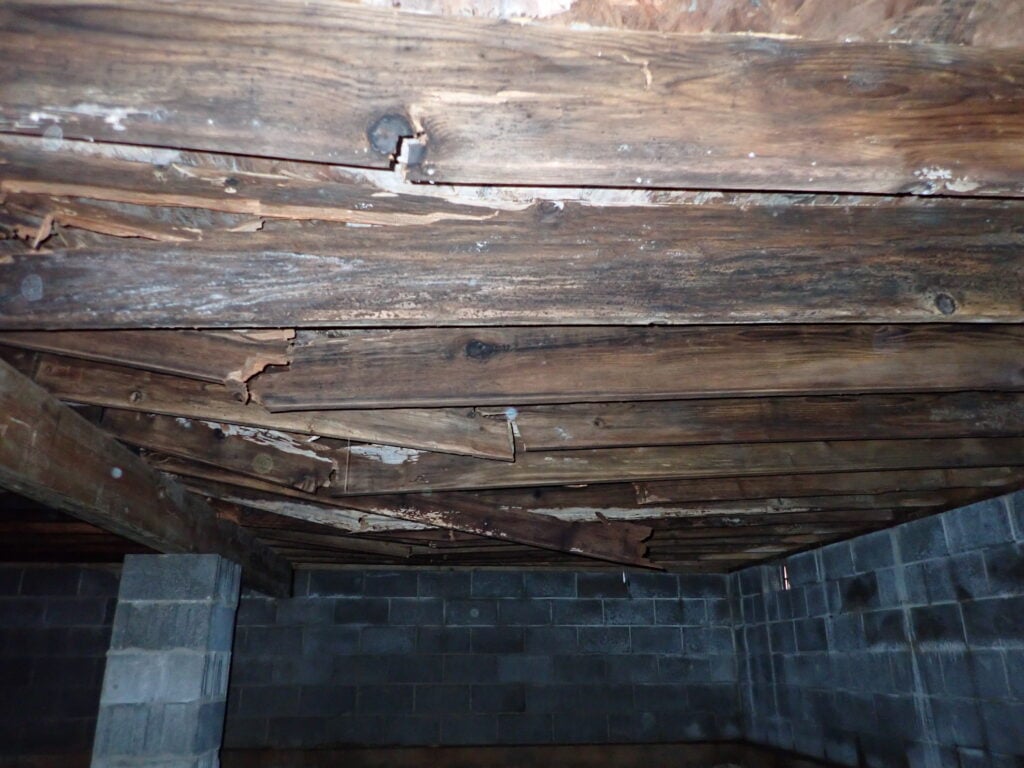
The photograph below shows severe floor joist rot and displacement due to a lack of crawlspace ventilation. Exacerbating factors in this case were that the crawlspace ground was exposed, and the living space above was left unheated for several winters. This resulted in relatively warm, moist air from the ground condensing on the floor joists cooled from above:
ADDITIONAL RESOURCES:
“Wood as an Engineering Material,” General Technical Report FPL-GTR-113, United States Department of Agriculture