Plywood vs OSB
Plywood and oriented strand board (OSB) are the two most common structural wood panel products used in residential and commercial construction. Both are widely used for roof, floor, and wall sheathing. Although they usually serve the same purpose and meet similar building code requirements, they differ in their manufacture, performance, and pros and cons.
Plywood is manufactured by peeling thin sheets of wood veneer from wood logs and then gluing the veneers together. The grain direction of each layer is oriented perpendicular to the previous layer. This cross-lamination increases strength and dimensional stability while reducing the tendency of the panel to warp. OSB, on the other hand, is manufactured by compressing thin wood strands with adhesives and resins under high heat and pressure. The strands are arranged in specific orientations, with the outer layers running lengthwise and the inner layers running perpendicular. This orientation is intended to increase strength and dimensional stability.
Because OSB is manufactured from arranged wood strands and resins, it is more uniform than plywood and typically straighter and flatter when purchased. It is also less expensive that plywood, and the material itself has higher shear strength than plywood. However, the installed shear capacity of a wood panel is usually governed by fastener capacity. This, combined with plywood’s better fastening characteristics, essentially negates the material shear strength advantage of OSB. While OSB is not susceptible to ply delamination like plywood, it is susceptible to swelling from moisture, particularly at cut edges.
Plywood has its own advantages and is generally considered superior to OSB. First, it is lighter than OSB, making it easier to handle. Plywood is also generally less susceptible to moisture than OSB. Plywood swells less when exposed to moisture, dries more quickly, and is more prone to return to its original shape. It is also stiffer than OSB, holds fasteners better, and produces less off-gassing because it typically contains fewer resins. Finally, plywood is smoother and easier to mark for accurate cuts.
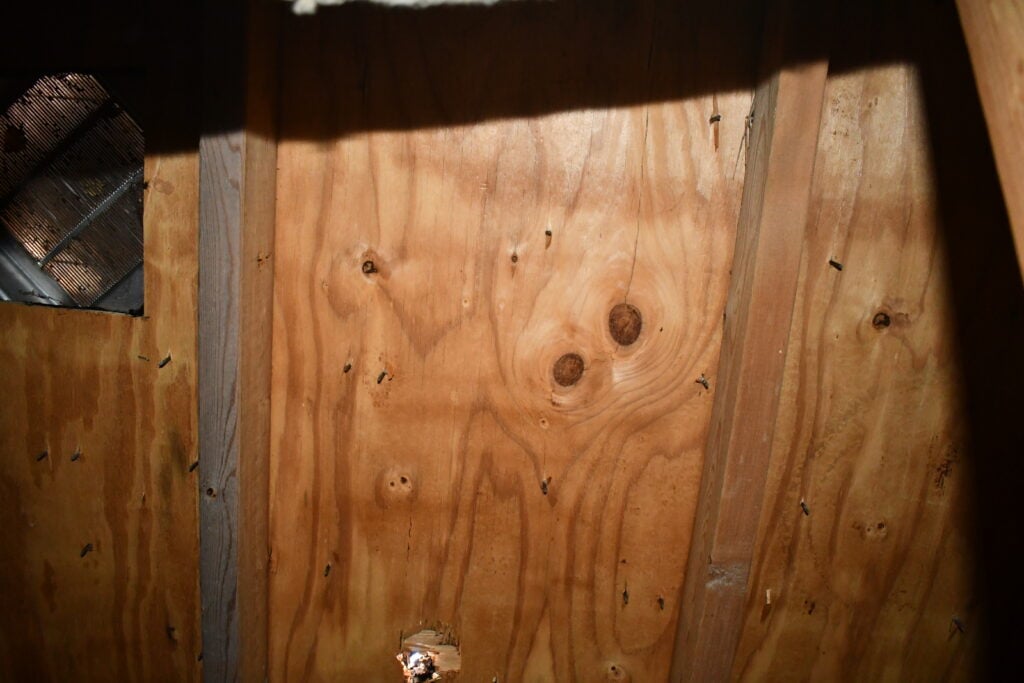
The photograph below shows installed plywood over roof trusses:
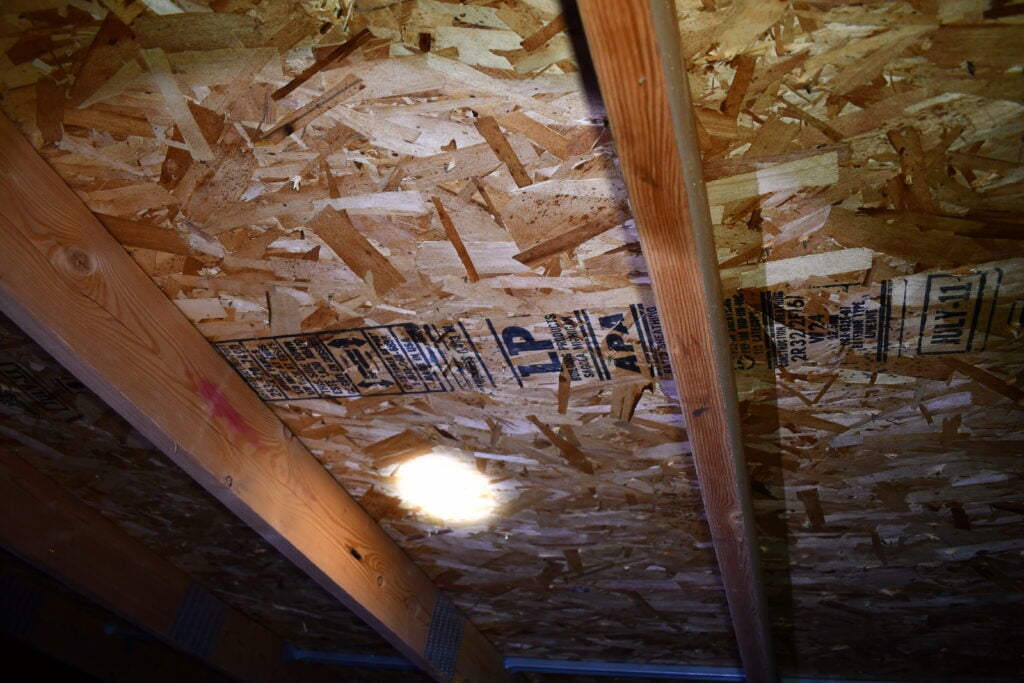
The photograph below shows OSB over roof trusses: