Cracks in Concrete Slabs on Grade from Settlement
Concrete slab on grade rely on the underlying soil for its support. As such, the soil beneath the slab could be considered to be a primary component of this floor structure. Changes that occur in the soil after a slab is placed can have a significant detrimental effects on the slab. These may include consolidation of organic material or loose sand, variations in the water content of clayey soils, and erosion of the soil from beneath the slab.
Many of these changes and their harmful effects occur over a significant period of time. The soil beneath a slab must be properly prepared prior to concrete placement in order to avoid or minimize such harmful changes and their effects on the structure.
Full support of the underlying soil allows a slab on grade to be constructed with little or no steel reinforcement. As concrete is strong in compression, a fully supported concrete slab easily transfers normal residential loads into the soil directly beneath the slab. However, the tensile strength of plain concrete is usually only 10 to 15% of its compressive strength. Therefore, without reinforcement, concrete is very susceptible to cracking due to tensile forces which result from bending.
Shear is another potential cause of cracks in concrete slabs. The shear strength of plain concrete is a function of its compressive strength and the area potentially affected by shear failure. Bending and shear develop within a floor slab or other structure that is partially supported or only supported at intervals. These forces are relieved when the slab cracks and settles, often under its own weight.
A small amount of settlement is normally considered in new building design since all new structures founded on shallow foundations settle to a limited extent. Structural damage does not usually occur as the result of settlement alone. For instance, if an entire building with all its foundations ‘sank’ exactly one inch into the earth at the exact same rate, the building itself would not be structurally damaged by the settlement alone. It is differential settlement that usually causes structural problems. Differential settlement occurs when one portion of a building or structure settles more than another. This differential movement induces unexpected and potentially severe forces within a structure, causing structural damage.
Settlement occurs for a number of reasons usually related to the initial preparation of the soil beneath the slab. Cohesionless soil (sand) that is not properly compacted prior to slab placement is susceptible to consolidation due to applied pressure and fluctuations in the water table. These fluctuations may occur during periods of heavy rain. In dry sand, internal friction and shear resistance increase with applied pressure. However, hydrostatic buoyancy, which occurs when the soil is submerged, reduces the pressures between the sand particles by about 50%. This translates into an approximately equal loss in soil bearing capacity, and effectively doubles the expected settlement.
Organic materials left in the soil before a slab is placed may decay or move with applied pressure over time. This can affect the bearing capacity of the soil supporting the slab. Clay soils are susceptible to plastic deformation, and may swell or shrink with more or less water content. Erosion of soil beneath or at the perimeter of a slab on grade is also a potential cause of settlement. This may occur as the result of missing or poorly directed gutter downspouts, groundwater runoff at steep grades, etc.
In summary, concrete slabs on grade need support from the underlying soil as they are not able to sustain their own unsupported weight. As such, a concrete slab on grade may settle and crack if the support soil is adversely affected, lost or diminished.
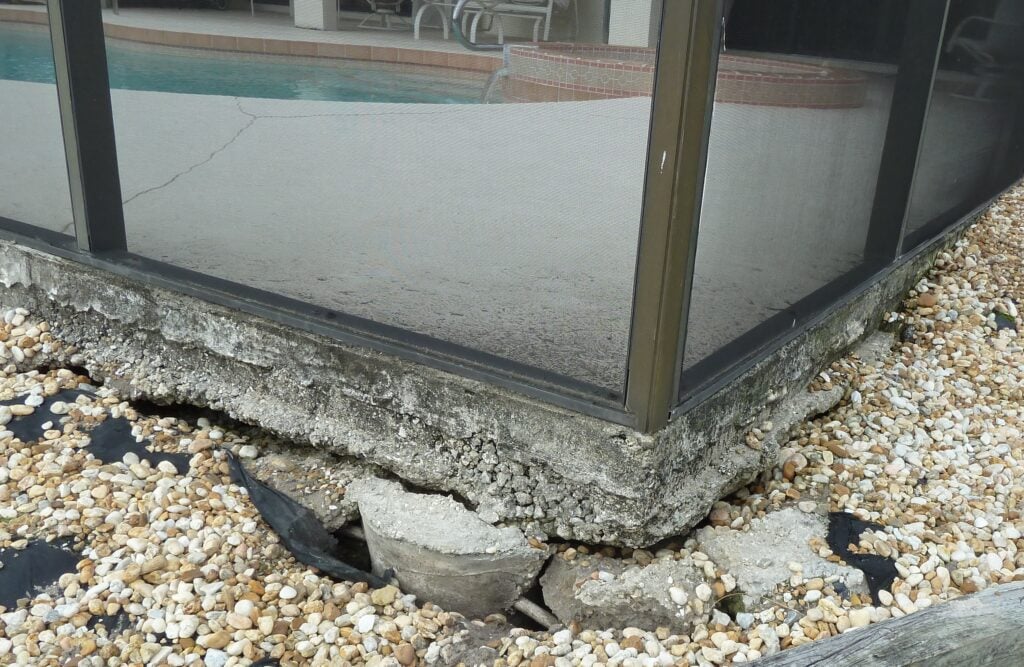
The following photograph shows significant settlement at the corner of a pool deck related to undermining of the soil visible at the deck edge near the settled corner:
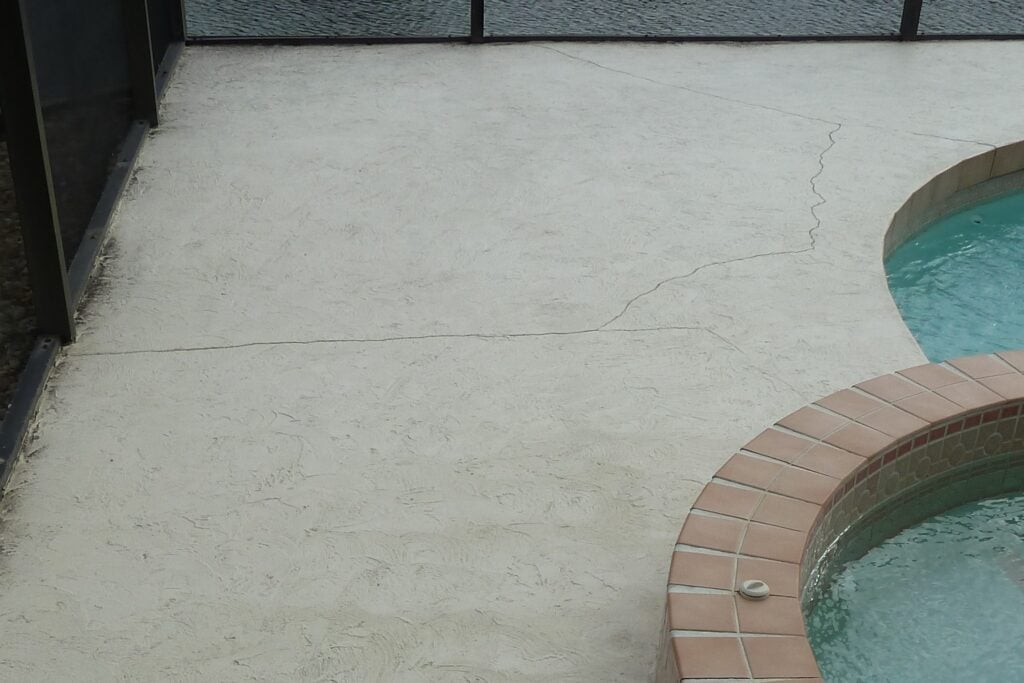
The same condition viewed from the pool deck. Note the corner at the upper left settled most, and the settled area rotated around the outside edge of the pool shell at right: