

Fasteners
From simple wood framing to complex anchoring systems, fasteners such as nails, screws, bolts, expansion anchors, tapcons, lag bolts, and powder-actuated fasteners each serve specific purposes based on load requirements, materials, and environmental conditions.
Nails are probably one of the oldest and most commonly used fasteners, particularly in wood construction. They are typically made of steel and driven using a hammer or nail gun. Nail guns are typically powered by air, but more electric guns or guns that are powered by both propane and battery are in common use today. Nails are classified based on their intended use, diameter, and length. Three common categories are common nails, box nails, and finish nails.
Common nails are the most widely used type for general construction, especially framing. They have a thicker shank and a large, flat head, providing strong holding power and resistance to bending. Box nails, on the other hand, have a thinner shank than common nails of the same length. This makes them less likely to split wood but also slightly weaker in both shear and withdrawal. Finish nails are designed for trim and finish work. They can have small, often barely visible heads that can be set below the wood surface and concealed with filler, making them ideal when aesthetics are a concern. Cut nails are another type of nail driven directly into concrete or masonry. These are made from harder steel and are shaped like a long rectangular wedge or a short, thick nail. The photograph below shows, from top to bottom: 16d box (galv), 16d common, 10d box (galv) and 10d common:
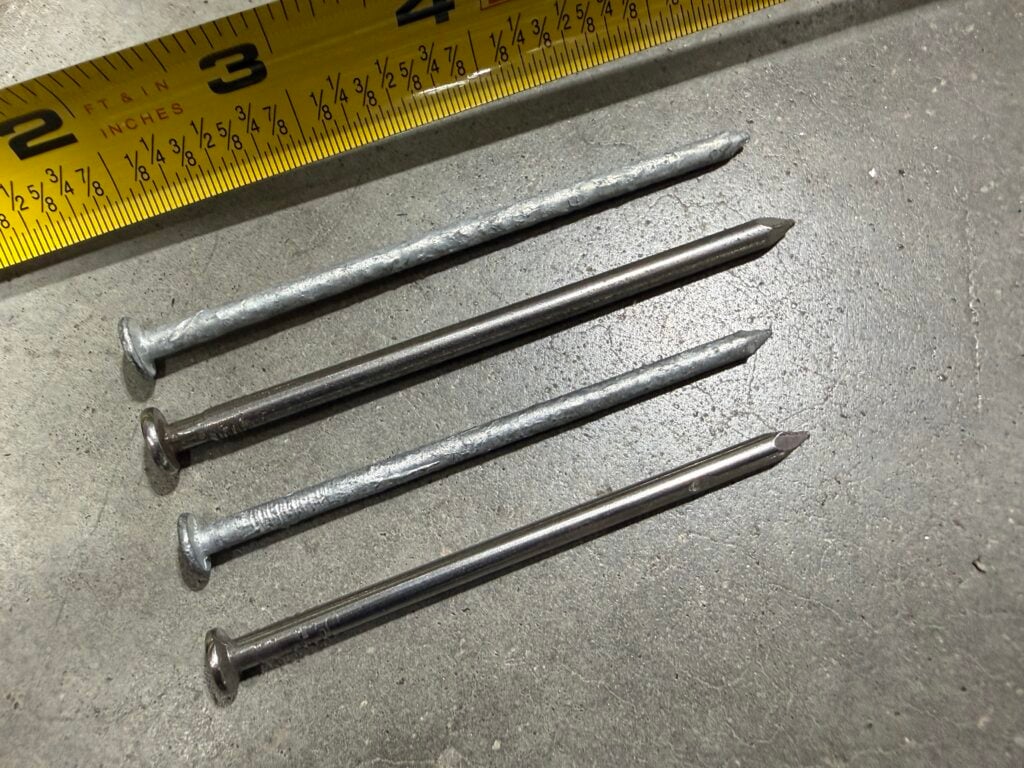
Nail sizes are described using the “penny” system, denoted by the letter “d.” For example, 8d, 10d, and 16d nails are common sizes in construction. The “d” historically stood for “denarius,” a Roman coin, and indicated the cost per hundred nails, but today it simply represents size. An 8d nail is typically 2.5 inches long, a 10d nail is 3 inches, and a 16d nail is 3.5 inches. The diameter also increases with size, affecting strength and application. For example, 16d common nails are often used for framing studs, while 8d nails are common for lighter structural work such as fastening plywood. 8d and 10d nails can be purchased in a length of 1-1/2 inches for fastening hangars to a single ply 2x.
Nails typically provided better shear capacity, but screws provide greater withdrawal capacity due to their threaded design, which allows them to grip material more securely. They are driven using a screwdriver or drill and are available in a wide variety of types, including wood screws, drywall screws, and self-tapping metal screws. Screws are particularly useful when disassembly may be required or when precise fastening is necessary.
Bolts represent a more heavy-duty fastening solution. In the context of construction, bolts often refer to ‘thru bolts’, which pass entirely through two or more components and are secured with a nut and washer on one or both sides. These bolts are commonly used in structural steel connections, heavier timber construction, or where multiple 2x plies are needed.
Bolts can also be embedded in set into concrete. Embedded anchor bolts with a 90 degree turn are placed in wet concrete before it cures, creating a permanent anchoring point. These are commonly used for securing structural columns, ledgers, etc. Alternatively, bolts can be installed into existing concrete using epoxy anchoring systems. In this method, a hole is drilled into the concrete, cleaned, and filled with an epoxy adhesive before inserting the threaded rod or bolt.
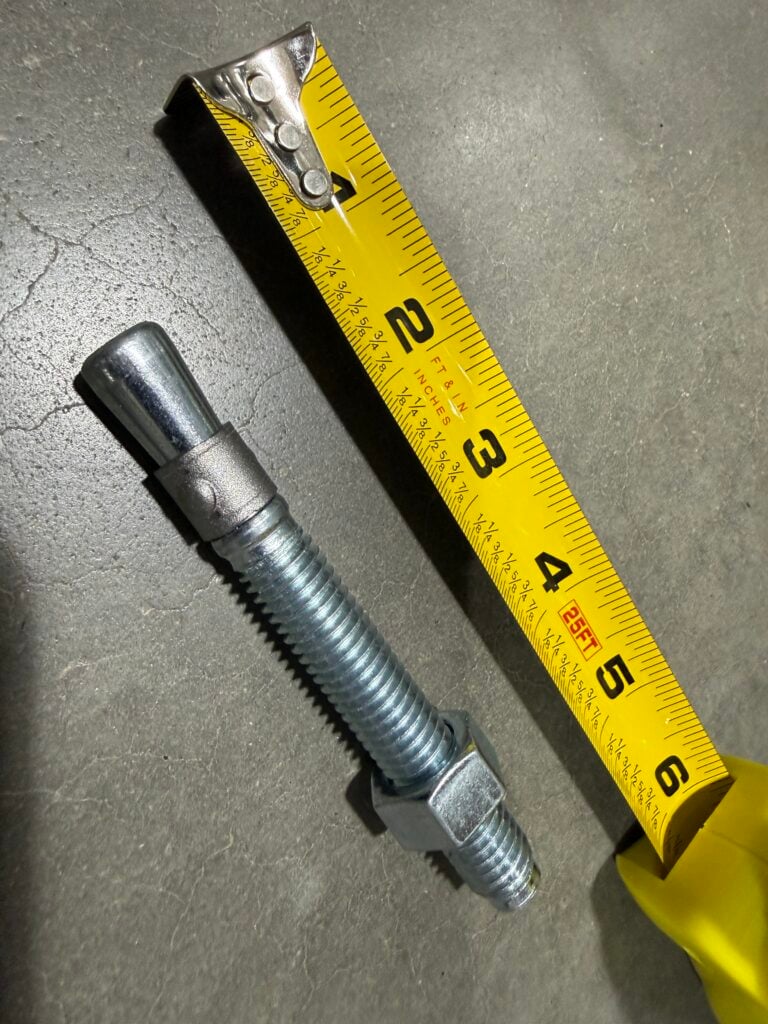
Expansion anchors are another method for fastening into concrete or masonry. These anchors work by mechanical expansion within a drilled hole, creating friction and mechanical interlock with the surrounding material. Common types include wedge anchors or sleeve anchors. Wedge anchors are particularly strong and are often used for structural applications. As the nut is tightened, a wedge mechanism expands against the sides of the hole, locking the anchor in place. The photograph below shows an expansion anchor:
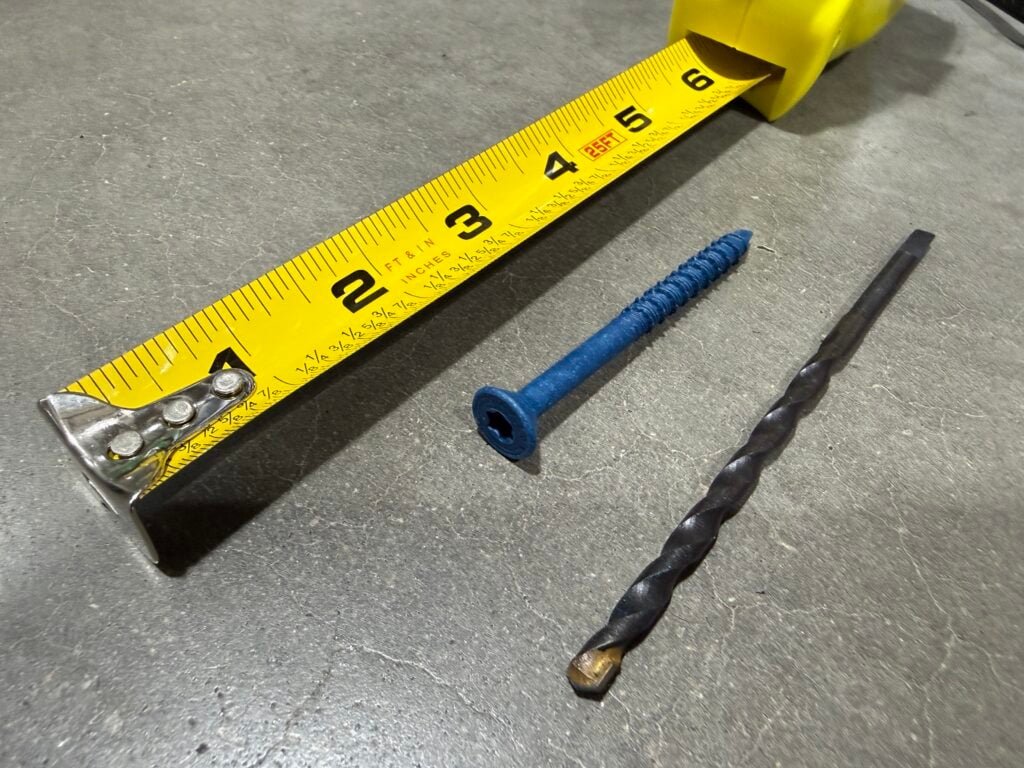
Tapcons are a popular brand of concrete screws designed to cut their own threads into a pre-drilled hole in concrete, brick, or block. Unlike expansion anchors, Tapcons do not rely on expansion but instead use hardened threads to grip the grooves they cut into the material. They are relatively easy to install and remove, making them suitable for lighter-duty applications such as attaching framing, electrical boxes, or fixtures to masonry or concrete surfaces. Proper hole size and depth are important to ensure adequate holding strength. They commonly vary in length from 1 inch to 8 inches and diameter from 3/16-inch to 1/2-inch. 3/16-inch and 1/4-inch diameter are most common. The photograph below shows a 1/4″ tapcon with its appropriate drill bit:
Lag bolts, also known as lag screws, are large, heavy-duty fasteners used primarily in wood construction. They resemble very large screws. They have a hex head and coarse threads and are driven with a wrench or impact driver. Lag bolts are often used for connecting heavy timber, securing ledgers in deck construction, or attaching structural hardware. Pre-drilling pilot holes is typically required to prevent wood splitting and to ensure proper installation.
Powder-actuated fasteners represent a specialized category used primarily in construction for fastening materials to concrete or steel. These systems use a controlled explosive charge, similar to a firearm cartridge, to drive a hardened steel pin into the base material. Powder-actuated tools are highly efficient for repetitive tasks such as attaching metal tracks or wood framing to concrete slabs. However, they require proper training and safety precautions. The fasteners used in these systems are specifically designed to withstand high impact and are not interchangeable with standard nails or screws.