

Ice Damming
Ice damming typically manifests as stains at an upper exterior wall, or at the ceiling just inside an exterior wall. The Building Science Corporation (www.buildingscience.com) describes ice damming as follows:
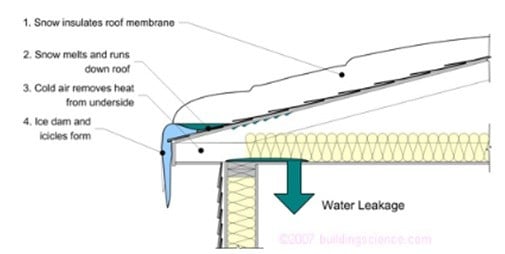
“Ice dams happen when the outside temperature is below freezing, the roof deck temperature is above freezing, and there is snow on the roof. The warm roof deck causes the snow on top of the roof deck to melt, and the melt water runs down to the edge of the roof where the water freezes leading to a buildup of ice and a backup of water, hence the term “dam”.”
and
“Simply put, ice damns (sic) are ridges of ice and icicles caused by meltwater from further up the roof re-freezing lower on the roof. The “dam” created by the ridge of ice along the eaves can trap further meltwater and result in significant leakage under and through the roofing, especially shingles and metal roofing. This leakage can cause damage to the sheathing, the roof structure, or the ceiling and walls below.”
The following schematic from the Building Science Corporation (buildingscience.com) illustrates a typical ice dam:
There are some conditions that increase the likelihood of ice dams. These include:
- A lower slope shingle roof. This allows ice to more easily block roof drainage and hold more water
- Failure to provide an ‘ice and water shield’ at the roof edge during the roof installation. This is a self-adhering membrane at the lower roof edge specifically designed to prevent ice dams
- Poor attic insulation and wider roof overhangs. These promote snow melting and freezing at the overhangs, respectively